By Madeleine Johnson | Valley News | Published: 11/13/2021 | Modified: 11/17/2021

The vineyards’ autumn leaves gild the hillsides, while mist lingers here in the valley of France’s Marne River. This is Champagne country and the harvest of the chardonnay, pinot noir and Meunier grapes was completed a few weeks ago. A spring freeze, a rainy summer and September storms mean that 2021 has not been a great Champagne year.
Today, though, it’s perfect October weather as I drive out of the Marne Valley and the town of Chateau-Thierry.
High above Chateau-Thierry, the colonnade of the American World War I monument stands out against a brilliant blue sky. With its manicured lawn and its view over a landscape neatly ordered by rows of grapes, it is hard to imagine the shell-torn landscape and carnage that this imposing monument rose from. Battles for this area on Paris’ eastern flank bookended World War I. During the First Battle of the Marne, in September 1914, the French barely kept the Germans from reaching Paris. In 1918, during the Second Battle of the Marne, it was newly arrived American troops — aided by German fatigue after four years of war — that kept the capital safe.
The monument to the American war effort is on Hill 204 — so named because it was 204 meters high on maps, a strategic height that cost thousands of lives. The colonnade’s base is carved with a map of the military action and the names and insignia of the American divisions that fought here encircle its plinth. In the center is the “YD” of the 26th Division, the “Yankee Division,” which was formed chiefly of units from New England. These included the 103rd infantry, most of whose members were National Guardsmen from Maine and New Hampshire. (The 103rd was also the only New England organization with full Native Americans from the Passamaquoddy tribe, all of whom were either killed or wounded).
Leaving the monument, I follow a classic, tree-lined French road along a ridge, turning off into another valley. Ahead are a square bell tower and two American flags on poles at the edge of a wood. They are surrounded by a wall with an imposing gate that opens onto an allée of trees. Rows of white crosses, and the occasional Star of David, fan out to both sides.
There are 2,289 crosses and stars here in the American Battle Monuments Commission’s Aisne-Marne Cemetery.
We tend to associate the Marne Valley and this cemetery with the famous American divisions that thwarted the German attempt on Paris in June 1918. The 3rd Division (during World War I, an American division had 28,000 men) kept the enemy from crossing the Marne at Chateau-Thierry, earning itself the name the “Rock of the Marne.” The 2nd Division checked German progress again in the Battle of Belleau Wood, a month of brutal, hand-to-hand combat that has become legendary.
Belleau Wood is often described as the war’s turning point. There still remained the huge challenge of pushing the “Hun” forces back to the borders they had violated in August 1914.
For that, it would take many other divisions and many more months of fighting. In the final days of June, the 26th Division would kick off this pushback.
31 New Hampshire graves
The 26th had already distinguished itself back in April at Seicheprey, when it was the first American unit attacked by the Germans. In the last days of June it arrived in Belleau Wood to take over from the exhausted 2nd Division. The men from New Hampshire in the103rd infantry found “Belleau Woods … was so devastated that it was no better than open country. Our men were compelled to lay in shell holes all day under heavy shell fire. Daylight lasted sixteen hours. …”
The sun was hot in June, and the stench was terrible.
Then, at 3:45 a.m. on July 5, 1918, starting in the fields just beyond where the Belleau cemetery wall is today, the New England troops began to hit back and deliver “the blow that sent the Hun reeling,” in the words of the divisional history.
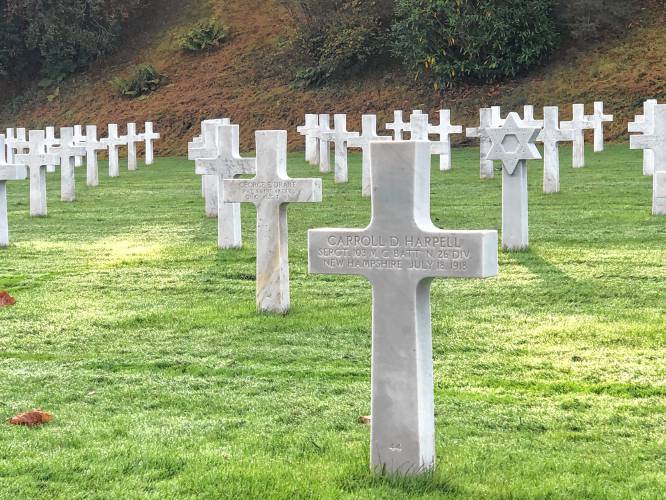
There are 31 New Hampshire graves in the cemetery at Belleau Wood. Death dates reflect the bloody campaign’s pattern. Clusters of headstones with July 18 and 21 record American attacks on German positions on the ridges that dominate this area of France. Less frequent are deaths from the days when the Germans would pull back to the ridge behind. The process would repeat for a month.
One July 18, 1918, grave honors Carroll Harpell, a machine gunner from Peterborough, who died of wounds. July 21 is on the cross of Joseph Clougherty from Manchester, who was fatally wounded during an attack that was particularly damaging to the New Hampshire regiment, which took heavy casualties after being separated from French troops protecting its flank.
One man who is missing from the Belleau Wood cemetery is New Hampshire hero Pfc. George Dilboy, who was killed during the July 18 attack. Although Dilboy enlisted from Keene, he was born in Greece. He received the Medal of Honor for single-handedly taking on a German machine gun, notwithstanding an almost-amputated leg.
After the war, families could choose whether to leave their loved ones’ bodies in France or bring them home. Dilboy’s father had his body moved from the Belleau Wood cemetery to his birthplace in Greece. When Dilboy’s grave was desecrated during the Greco-Turkish War of 1919-1921, President Warren Harding arranged to have the remains transported to Arlington National Cemetery, where they are today.
Commemoration of American dead went beyond the American Battle Monuments Commission. Families, individuals and military units found many ways to remember the war experience. The 2nd and 4th divisions erected markers along their routes. Wealthy families built private monuments or chapels. Others helped France rebuild. Harvard design school students helped reconstruct a Champagne village, while the state of Pennsylvania rebuilt a bridge damaged during Pennsylvania troops’ fighting.
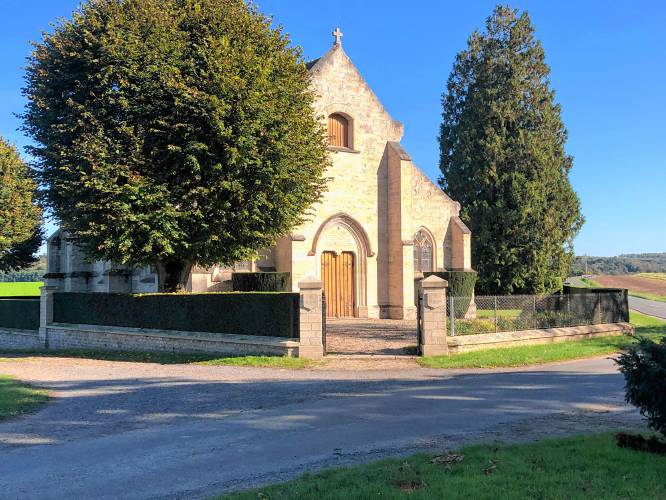
When American artillery destroyed the village church of Belleau, the 26th Division’s Gen. Clarence Edwards vowed to rebuild it. Yankee Division veterans donated enough money to build a completely new church on a new site next to the Belleau Wood cemetery. While the church is considered the 26th Division’s “official” memorial, it is also an active parish church for the village of Belleau, which owns it.
Pilgrimage to France
After visiting the New Hampshire graves in the Belleau Wood cemetery, I pick up the church’s key from the superintendent of the cemetery. Inside, the Yankee Division flag hangs over the Romanesque nave, framing the altar that New Hampshire veterans donated. Autumn sun pours through the stained-glass windows depicting typical American and French soldiers; the “Doughboy” in his field khaki and the “Poilu” in French blue. The eagle-shaped lectern is a survivor of the original church. The names of the 26th Division’s dead are inscribed on the church’s limestone walls.
Behind the church lie the ridges from which the New England men had to dislodge German troops. Heading toward them, I pass the low wall of another cemetery, this one for 8,000 German dead. A spare black crucifix is its only adornment. There are surprisingly few headstones. Another 4,000 dead have no headstone at all; they rest in a single mass grave (only 487 of their names are known). The harsh terms of the November 1918 armistice forced the Germans to vacate France in 14 days and leave “care” of their dead to the French military.
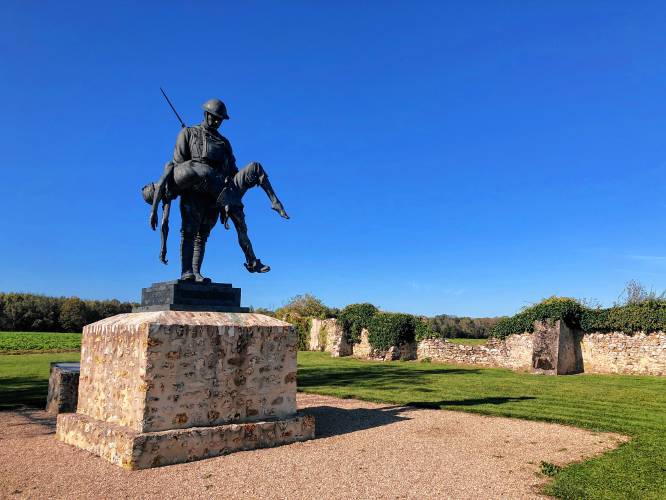
From Belleau, I follow the Yankee Division’s campaign in the Marne Valley to its end on July 25, 1918. After 20 days of fighting for 10 miles, the 26th Division was relieved by the 42nd Division at Croix Rouge Farm. The spot is marked by the farm’s ruined walls and the 42nd Division’s World War I monument. This is a recent memorial, created in 2011, through the generosity of one man and the Alabama foundation that purchased the land. On this day, the jagged profile of a statue representing a soldier cradling his wounded companion cuts into the cloudless sky.
In 1922, Britain’s King George V made “The King’s Pilgrimage” to World War I graveyards, monuments and battlefields. He was followed by thousands who braved France’s lunar landscape of shell holes and ruined buildings to see where loved ones fought or died.
In 1927, 25,000 veterans went on an American Legion pilgrimage to France. During the 1930s, 6,000 American mothers and wives joined government-paid and organized Gold Star pilgrimages to visit their sons’ and husbands’ graves. The Battle Monuments Commission cemeteries offered rooms where visitors could stay and published a guide of several hundred pages for “motorists” visiting war sites.
New Hampshire professor Heather Warfield, a pilgrimage studies scholar with a focus on post-World War I Western Front pilgrimages, says these were therapeutic journeys with many facets. Battlefields were hallowed ground, where pilgrims could “commune with those gone to another life.” Pilgrimages were often a commitment to peace.
Veterans of the 26th Division came on their own pilgrimage in 1929. They visited battlegrounds and the Freudmont quarry, where they carved their names and unit insignia when they bivouacked there. Many visited the French families and children they had billeted and bonded with during the war. At Belleau they joined French soldiers and civic and religious authorities to dedicate the new village church, which also commemorated the division’s dead. They made a final pilgrimage in 1953.
Today, Warfield and a team of scholars, French World War I enthusiasts and photographers are creating a new kind of pilgrimage for the 26th Division. With support from New Hampshire Humanities, they are building a “virtual pilgrimage” platform that is underpinned with a digital archive. Panoramic images let viewers “enter” and “explore” 26th Division sites in the Marne region, including the Belleau church and the Freudmont quarry.
Clicking on New Hampshire graffiti in the quarry or names inscribed in the Belleau church opens a digital archive with information. Warfield says families will be able to enrich this information with their own photos, documents and information. The first phase of the digital pilgrimage is to go live in January 2022. The site is to become fully operational as a tool for teachers and an instrument for understanding in August 2022.
A presence in these hills and valleys
Detailed as it might be, one thing that this digital pilgrimage can’t recreate is what many people feel in this landscape.
Gilles Lagin, a local guide and authority on American action in the Marne, says: “When some people drive here, they just see the road. I see trucks, ambulances and thousands of men. Many who would lose lives.” Even if you don’t see such images, you can feel an ineffable presence in these hills and valleys. Some say it comes from all the blood shed on the ground. Those who spend time here, doing historical research, caring for monuments or offering hospitality to visitors, say ghosts are always with them.
Whatever it is, the Marne area shows nature’s healing work.
After the war, farmers noted with horror how well crops and vegetables grew where phosphorous-based gas had been deployed or bodies were buried. Today, trench lines and foxholes, which are still visible in woods if you know where to look, are gradually filling in with leaves and debris. Terrain riven by shell holes and strewn with barbed wire now produces grapes, sugar beets and rapeseed.
With its reputation for hardiness, the 26th Division would be asked to repeat the pattern of bloody uphill assaults that began in July, earning a second nickname as the “sacrifice division.” Many felt that the 26th Division’s superior fighting skills and physical endurance were undermined by ineffectual leadership.
In September, the division fought at St. Mihiel, which was the first battle entirely organized by American leadership. In October and November, the 26th joined the war’s final campaign in the Meuse-Argonne (still the biggest battle ever fought by American troops; 47 days and over 1.2 million American troops).
At the armistice on Nov. 11, 1918, the division had 210 days in action and casualties of 1,587 dead and 12,077 wounded. New Hampshire men accounted for 40% of these.
The terrain around Chateau-Thierry, where the Yankee Division gave so much, was a tough adversary. But it could also be an ally. American troops rushing into the line to stop the German advance on Paris in June 1918 gained a few extra days to reach their positions because German troops had slowed their advance to loot — and get drunk — on the bubbly white wine stored in the cellars of the Marne and Champagne region.
Madeleine Johnson, of Enfield, is a freelance journalist who has studied the Marines in World War I for many years.
 Madeleine Johnson