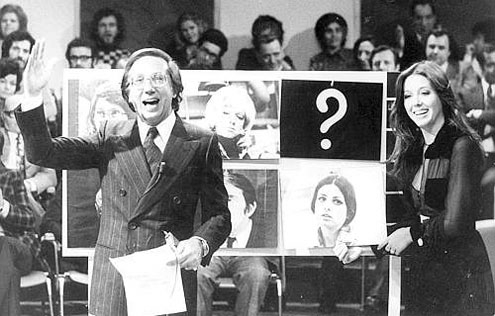
In a recent article in the Milan daily Corriere della Sera, columnist Ernesto Galli della Loggia encouraged legislative changes that would streamline Italy’s naturalization procedures. As part of a proposed law, the citizenship process could take five years instead of the current 10, so long as adult applicants proved a working knowledge of Italian and of “civil life in Italy and the constitution.” At the same time I also learned that the Educational Testing Service, the folks that write and administer the American SAT test, has a global branch that helps write tests for foreign ministries. Here are some sample questions for an Italian citizenship exam.
— The Italian head of state is:
- a. Silvio Berlusconi;
- b. Giorgio Napolitano;
- c. Pippo Baudo;
- d. Pope Benedict XVI.
— The abbreviation “P2” refers to:
- a. The morning after pill opposed by the Vatican;
- b. A rogue Masonic lodge implicated in a 1980s political scandal;
- c. A colloquial name for the second year of a liceo classico;
- d. A new kind of mobile phone.
— Padre Pio is:
- a. The center of a lucrative cult that aims to defraud and delude the credulous;
- b. The priest who administered the last rites to Elvis Presley;
- c. A saint whose good works and popularity has attracted envy and hostility from the Roman Catholic Church hierarchy;
- d. The patron saint of taxi drivers.
— The Posta Italiana (PT):
- a. Sells stamps;
- b. Sells financial products;
- c. Sells music CDs featuring Italian artists;
- d. Delivers mail;
- e. All of the above except D.
— The Risorgimento refers to:
- a. The violent colonization of the Italian south by the Piedmontese military machine
- b. A common name for a street or piazza in Italy;
- c. An Italian department store;
- d. A popular movement that led to the unification of Italy and its becoming a modern nation-state;
- e. The introduction of modern civilization to the backwards and corrupt Italian southerners by enlightened northerners.
— The correct procedure to adopt when behind a slower vehicle in the left lane of the autostrada is:
- a. Approach the slower vehicle until reaching a one car-length distance and flash lights. When the slower vehicle moves to let you pass, wave cheerily.
- b. Approach slower vehicle at high speed to a distance of one-meter and flash lights vigorously. When slower vehicle lets you pass, wave.
- c. Same as above, but if driver of the slower vehicle fails to change lanes, accelerate and pass on the right. Make rude gestures and swear.
- d. Any of the above but without the hand gestures.
— The Italian national anthem is:
- a. “Fratelli d’Italia” by Goffredo Mameli;
- b. “Vincerò” by Giacomo Puccini;
- c. “Va Pensiero…” by Giuseppe Verdi;
- d. “Bella ciao” by an unknown hero of the Marxist Resistance;
- e. “Nel blu dipinto di blu (Volare!)” by Domenico Modugno and Franco Migliacci.
— Fascism and its leader Benito Mussolini were:
- a. A political movement that was occasionally violent but made the trains run on time;
- b. A political movement that gave Italy the international role it deserves until it was undermined by a conspiracy of Communists and Anglo-Saxon capitalists;
- c. The only Italian government that might have crushed the Mafia;
- d. A political movement that combined centralized socialist economic policies with a dictatorship and personality cult.
— The Red Brigades are:
- a. Volunteer groups that clear away red algae blooms affecting Italy’s Adriatic coast;
- b. The Italian branch of Germany’s now-defunct “Red Army Fraction”;
- c. A violent, left-wing group that kidnapped and killed Christian Democrat leader Aldo Moro in 1978;
- d. A popular Milan hip-hop group whose political lyrics are critical of imperialist multinationals and the EU.
— Raccommandazione refers to:
- a. A kind of letter whose sending requires filling out fiddly little forms;
- b. The 1929 agreement reached by Mussolini that formalized relations between the Italian state and the Catholic church;
- c. The practice of calling on members of the same social or familial clan to secure sustenance in the form of jobs, academic positions or career advancement;
- d. The legislative policy that makes Sicily and the Trentino autonomous regions;
- e. The name that hardline Communists gave to the party they formed after the fall of the Berlin Wall.
— A bidello is:
- a. A kind of long pasta typical of the Veneto region which is usually dressed with an anchovy-based sauce;
- b. A house of prostitution. Also used colloquially to mean “a big mess”;
- c. The Italian bathroom fixture that non-Italians mistakenly think is a second toilet;
- d. A school staff member who appears to do everything but is responsible for nothing.
— You face the esame di terza media, or upper level high school exams, in two weeks and haven’t studied all year. You…
- a. Study hard and try to catch up;
- b. Copy the answers of the student beside you during the exam;
- c. Nothing. Everyone fails sometime;
- d. Nothing. A well-connected uncle will ensure you get a raccommandazione.
— Which of the following is known to cause cancer among Italians?
- a. Drafts;
- b. Indigestion;
- c. Not wearing a woolen undershirt;
- d. Smoking.
— Which of the following is appropriate while waiting for an appointment with a doctor or state bureaucrat?
- a. Discussing health details such as your bowel movements with strangers;
- b. Keeping your seat despite the presence of pregnant women or the elderly;
- c. Walking in on someone else’s ongoing appointment because you have a “minor” question;
- d. Waiting your turn.
 Madeleine Johnson